
Self-Serve, Full-Service, or Enterprise? How to Choose How Much of the R&D Credit Work to Carry Yourself
Every Strata tier ends with a filing-ready study your CPA can file. The real question is how much of the work your team wants to carry. Three questions help you decide.

TL;DR
- Every Strata tier ends in the same place: a filing-ready study your CPA can file with the return. The tiers differ in how much of the work your team keeps.
- Self-Serve is built from your own data. Full-Service adds a dedicated team, a specialist CPA, and a full methodology memo. Enterprise is Full-Service delivered in person and shaped around a larger or more complex organization.
- Three questions usually point to the right fit: how sure you are of your numbers, how much time your team can spare, and how many moving parts your business has.
Start with what the credit is
The federal research credit (Section 41 of the Internal Revenue Code) rewards businesses that develop or improve products, processes, software, or techniques through work involving technical uncertainty and experimentation. Whether you work with a specialist or go lighter-touch, the credit itself is determined by the same rules. What changes from one path to the next is who does the work of gathering the facts, calculating the credit, and putting the documentation together, and how much support stands behind it afterward.
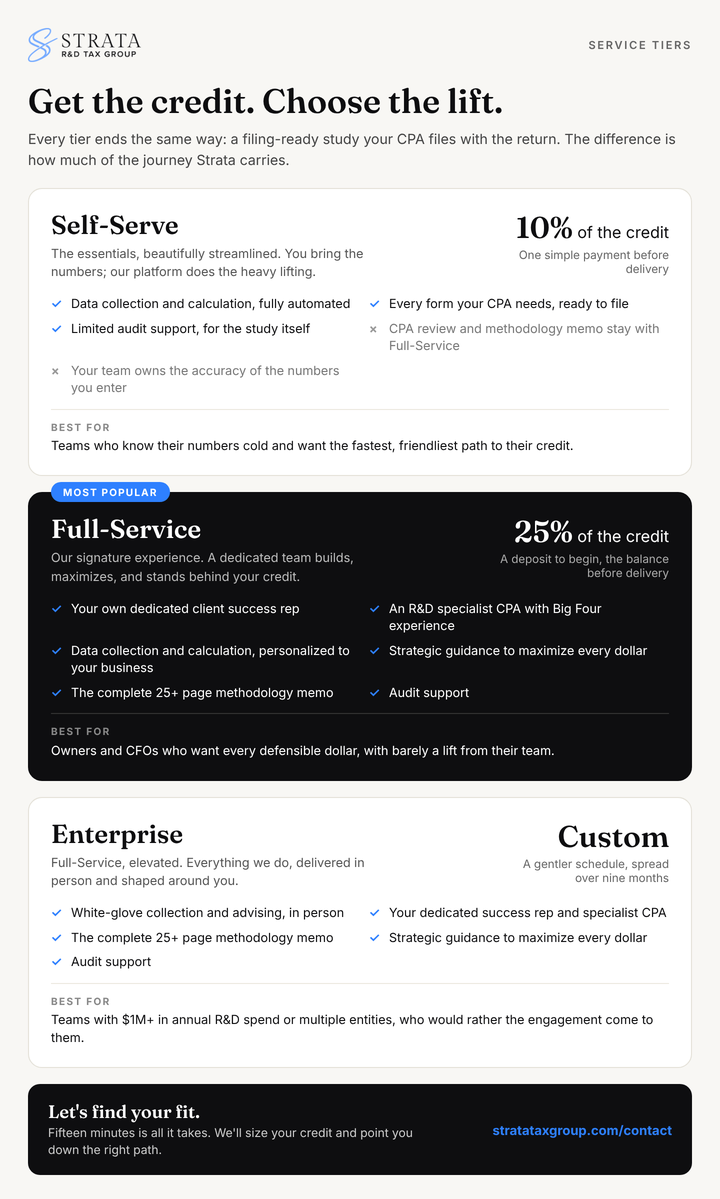
In every case, the fee is a share of the credit identified, so the cost scales with the size of the credit. The initial conversation is a 15-minute review, and Strata's initial assessment is $0.
Question 1: How well do you know your own numbers?
Self-Serve is built for teams who know their numbers cold. The platform automates data collection and calculation from the information you provide, and your team owns the accuracy of what you enter. That is a good arrangement when your records are tidy, your project and payroll information is easy to pull together, and you are comfortable standing behind your inputs.
If you are less sure which activities qualify, how to tie wages to projects, or whether you are leaving eligible work out, a team that personalizes the data collection and calculation to your business may be worth considering. Under the regulations, records need to be kept in sufficiently usable form and detail to support a claim, and a methodology memo is one way of building that support. The memo is part of Full-Service and Enterprise, not Self-Serve.
Question 2: How much of your team's time can you spare?
Full-Service is designed for owners and CFOs who want every defensible dollar with barely a lift from their team. A dedicated client success rep and an R&D specialist CPA carry most of the load. Self-Serve asks more of your people, because the platform assumes your team is doing the gathering. Enterprise goes further: collection and advising happen in person, so the engagement comes to you.
Strata's process is structured and guided on every path, and the time asked of your team depends on the tier you choose. If bandwidth is your main concern, say so in the first conversation; it is one of the clearest signals for which tier fits.
Question 3: How many moving parts does your business have?
Enterprise is for teams with $1M+ in annual R&D spend or multiple entities, and for leadership teams that would rather the engagement come to them. It includes everything in Full-Service and adds in-person collection and advising. The fee is custom, with a payment schedule spread over nine months, which some larger organizations find easier to plan around.
If your business is a single entity with a more contained level of R&D spend, Full-Service often covers what you need without the added scope.
A quick way to sort yourself
- Confident in your data, want the fastest and most affordable path to a filed credit: Self-Serve is likely worth a look.
- Want every defensible dollar with minimal effort from your team, and a specialist CPA behind it: Full-Service is likely the fit.
- $1M+ in annual R&D spend or multiple entities, and want in-person service shaped around you: Enterprise is likely the fit.
None of these is a permanent choice, and none is right for everyone. The best match depends on your facts, your records, and how you would like to spend your team's time.
Not sure which fits?
Start with a 15-minute review. We will size your credit, answer your questions, and point you toward the right path. You can request one here. For background on the credit itself, see Section 41 of the Internal Revenue Code and the IRS's About Form 6765 page. In every case, you pass the finished package to your CPA, who files the return.
This post is for informational purposes only and does not constitute tax or legal advice. Consult a qualified tax professional regarding your specific circumstances.
Author
Strata R&D Tax Group