New Model, Refresh, or Custom Order? A Project-by-Project Decision Framework for Boat Builders
Not every project in a boatyard belongs in an R&D credit claim, and not every one is left out. Five questions can help you sort new models, refreshes, and custom orders.

TL;DR
- The R&D credit is claimed at the project level, so a boat company may have qualifying and non-qualifying work in the same model year.
- Five questions can help you sort each project: what changed, what was uncertain, how you resolved it, whose requirement drove it, and whether production had already begun.
- Looks, finish, and trim are generally outside the credit. Hull form, structure, materials, and process development are where qualifying work may be found.
What the credit is, in a few words
The federal research credit rewards U.S. businesses for developing new or improved products and processes, and the rules sit in IRC Section 41 and Treasury Regulation 1.41-4. It is calculated from qualifying wages, supplies, and certain contract research. It is claimed on Form 6765.
The rules look at activity, not at company type. A boat builder can qualify, but only for the projects and activities that meet the tests, depending on the specific facts and documentation.
Why boat builders need a project-by-project view
A typical builder runs several kinds of work at once. There may be a new hull in development, a model-year refresh of an existing line, a one-off custom order for a particular owner, and a steady flow of production boats. Each one raises a different eligibility question.
A single “yes” or “no” for the whole company is not how the credit works. The useful question is which projects, or which parts of them, may qualify. The framework below is a way to ask it consistently.
Question 1: What actually changed?
Start with the change itself. Credit-eligible work is aimed at a new or improved product or process in terms of function, performance, reliability, or quality. For a boat, that might be hull form, structural layup, a new rigging or drive arrangement, a different core or resin system, or a new way of building a part.
Work that relates to style, taste, cosmetic, or seasonal design factors is treated differently. Under IRC 41(d)(3)(B), research relating to those factors is not treated as conducted for a qualifying purpose. New graphics, upholstery colors, and trim packages usually fall here.
- Leans toward qualifying: a redesigned hull form for better ride or efficiency, a lighter laminate schedule, a new engine bed or stringer structure.
- Leans toward not qualifying: new color options, a different seat pattern, a cosmetic console restyle.
A model-year refresh is often a mix. The cosmetic portion generally sits outside the credit, while a real structural or performance change inside the same refresh may be worth looking at separately.
Question 2: Was there real technical uncertainty?
Ask whether your team knew at the start how to achieve the result, or even whether it could be achieved. Uncertainty might involve capability (can we build this?), method (how should we build it?), or design (what is the right configuration?).
If the answer was known going in, because you were repeating an approach you have used before, the project may not clear this bar. If your engineers genuinely did not know whether a new hull would plane at the target weight, or whether a new layup would hold up, that is the kind of uncertainty the credit looks for.
Question 3: How did you work through it?
The credit looks for a process of experimentation: evaluating alternatives through modeling, simulation, prototyping, or systematic trial and error. In a boatyard that may look like test panels, plug and mold revisions, material trials, tank or water testing, and sea trials that led to a design change.
A useful gut check is whether you tried more than one approach and learned from results that did not work. Projects where the first design simply went into production without being tested or revised are less likely to show this.
Question 4: Whose requirement drove the work?
Two exclusions are especially relevant to builders:
- Adaptation. Under IRC 41(d)(4)(B), research related to adapting an existing business component to a particular customer’s requirement or need is excluded. A custom order that mostly rearranges proven components to fit one owner’s layout may fall here.
- Duplication. Under IRC 41(d)(4)(C), research related to reproducing an existing business component is excluded, including from a physical examination of the component itself or from plans and specifications.
Custom does not automatically mean ineligible. A custom order that required solving a real structural or performance problem your team had not solved before can look different from a pure layout change. The question is what the engineering work was, not simply that the customer asked for it.
Customer contracts matter too. If a customer funds the work, the terms on risk and rights can affect whether the research is treated as funded. That is a contract-by-contract question worth raising with a specialist.
Question 5: Had commercial production already begun?
Under IRC 41(d)(4)(A), research conducted after the beginning of commercial production of the business component is excluded. For a new model, the work done to design, test, and refine it before it enters regular production is where the credit may apply. Work after the model is in steady production, such as routine fixes and ongoing line support, generally does not.
Processes can have their own clock. A new build method may have its own development period before it becomes the standard way a shop works, and the regulations also include a rule that lets you apply the tests to the smaller part of a component where the full component does not qualify. Those details depend on the facts.
Putting it together: a quick sort
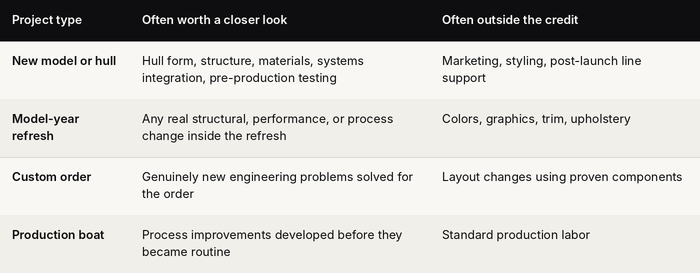
Use this table as a starting point only. Real projects land in the gray areas, and the answer depends on the specific activities, documentation, and facts.
What to keep so the answer is usable later
You do not need to overhaul your systems. Notes you already generate can go a long way if they show what changed and why: design revisions, test results, material trial records, change orders with a short reason, and who worked on which project. Keeping a simple project list by model year makes the sorting above much faster when it is time to look at a claim.
A note on results
One Strata client, a boat builder, identified more than $300,000 in credits after a study of its work. Individual results vary, and every claim depends on the company’s own projects, documentation, and facts.
Where Strata’s service options fit
If you decide a study is worth pursuing, Strata offers Self-Serve, Full-Service, and Enterprise engagements, which differ in how much of the work your team carries. Which one fits depends on how much time you want to spend and how complex your operations are. The initial assessment carries no cost to you, and a typical study takes roughly 4 to 8 weeks, depending on how quickly information comes together. Your team’s time commitment is modest, and your CPA files the return with the study.
Next step
If you are not sure which of your boat projects might count, a short conversation is a good place to start. Book a 15-minute review at stratataxgroup.com/contact and we can talk through your model lineup and where qualifying work may sit.
This post is for informational purposes only and does not constitute tax or legal advice. Consult a qualified tax professional regarding your specific circumstances.
Author
Strata R&D Tax Group