How a Utah A/V Integrator Documented a $300K+ R&D Credit (And What Similar Shops Can Learn)
A closer look at how one Audio & Visual integration firm surfaced a $300K+ federal R&D credit, and the kind of custom integration work that can qualify.
- Vertical
- Audio & Visual / System Integrators
- Credit
- $300K+

TL;DR
- One Audio & Visual integration firm identified a federal R&D credit of more than $300K by documenting the custom engineering work already inside its projects. Individual results vary based on each company's specific activities, documentation, and facts.
- Much of what qualifies is not lab work. It is the trial-and-error of integrating disparate systems, writing custom control logic, and solving acoustic and signal problems that off-the-shelf products do not answer.
- The credit turns on the IRS four-part test and clean documentation, not on how impressive the room looks at the end.
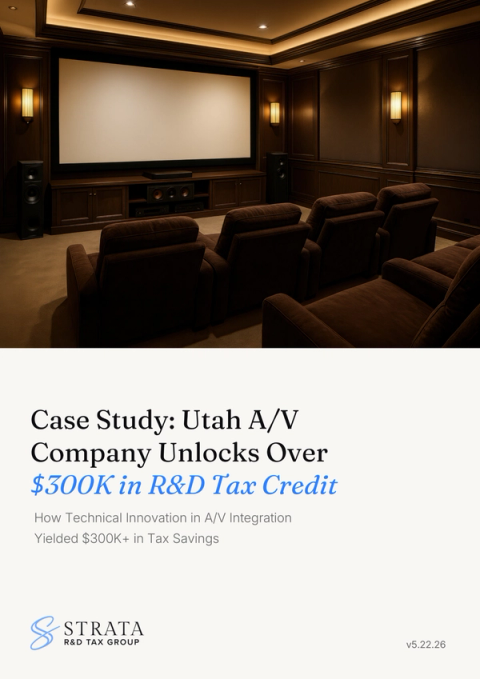
Read the full Utah A/V case study to see how it worked.
Most Audio & Visual integrators we talk to assume the R&D tax credit is for software companies and pharmaceutical labs, not for a shop that designs and installs custom systems. That assumption can leave real money on the table. The federal credit was written to reward the process of solving technical problems, and a lot of A/V integration work is exactly that: figuring out how to make systems perform when there is no guaranteed path from spec to finished room.
To make the idea concrete, consider one Audio & Visual integration firm that worked through this process and documented a federal R&D credit of more than $300,000. We are keeping the firm anonymous, and the specifics below are illustrative of the kind of work A/V integrators commonly do rather than a blow-by-blow of one client's file. Individual results vary depending on the specific activities, documentation, and facts of each business.
What the federal R&D credit actually covers
The credit lives in Section 41 of the Internal Revenue Code, with the qualifying-activity rules spelled out in Treasury Regulation 1.41-4 (ecfr.gov). For a plain-language overview, the IRS also maintains a summary of the credit at irs.gov/businesses/research-credit. It is a credit for qualified research, and the IRS uses a four-part test to decide what counts. All four parts have to be met for a given activity:
First, the work has to be technological in nature, meaning it relies on principles of engineering, computer science, or the physical sciences. Second, it has to serve a permitted purpose: developing or improving the functionality, performance, reliability, or quality of a product, process, or system. Third, there has to be technical uncertainty at the outset, where the company does not already know whether it can achieve the result, or how. Fourth, the company has to work through a process of experimentation, evaluating alternatives through modeling, simulation, testing, or systematic trial and error.
The four-part test is the whole game. Work that clears all four parts can qualify. Work that skips one, for example a job where the outcome was never in doubt, generally does not.
What qualifying activity can look like for an A/V integrator
In the case above, the credit did not come from one dramatic invention. It came from adding up the technical problem-solving spread across many projects over the year. That is typical.
The kind of A/V integration activity that may qualify often includes: developing custom control-system programming and automation logic where standard drivers do not exist or do not behave as needed; engineering signal-distribution and networked-AV architectures that have to hold up under real bandwidth, latency, and synchronization constraints; solving acoustic problems in difficult spaces through iterative modeling and on-site testing; and integrating hardware and software from multiple manufacturers that were never designed to talk to each other, then resolving the failures that surface when you try. In each of these, the integrator starts without knowing whether the approach will work and has to experiment to find out. That uncertainty and experimentation are what the credit is built around.
It is just as important to be honest about work that typically does not qualify. Routine installation of standard equipment to manufacturer specifications generally does not, because there is no real technical uncertainty. Neither does rack-and-stack of pre-configured gear, cosmetic or aesthetic design choices, ordinary project management and scheduling, routine service and maintenance calls, or simply repeating a system you have already built the same way before. If a job is essentially applying a known solution, it usually falls outside the credit, no matter how much skilled labor it takes.
The honest version of this is that a given A/V project often contains both. The custom control logic and the multi-vendor integration may qualify while the standard cabling and mounting alongside it do not. Sorting the qualifying activity from the routine, and documenting it contemporaneously, is where most of the real work sits.
If you own or run the firm, here is what next steps look like
For a business owner or CFO, the first question is eligibility, not paperwork. A short conversation can usually tell whether there is enough qualifying activity to be worth pursuing. Strata offers a $0 initial assessment to make that first look low-risk, and a typical engagement runs about four to eight weeks depending on the complexity of the work and the state of your records.
The single biggest factor in a defensible claim is documentation created while the work is happening: design iterations, testing notes, programming revisions, and records of the problems you hit and how you worked through them. Firms that capture this as they go tend to have a much smoother substantiation process than those trying to reconstruct it a year later. Strata's role is to help identify which activities may qualify and to document them against the four-part test so the claim can stand on its own.
FAQ
We mostly install other manufacturers' equipment. Can any of that qualify?
Possibly. Installing standard gear to spec generally does not qualify, but the engineering you do to make disparate systems work together, especially custom programming and integration that involves real technical uncertainty, may qualify depending on the specific activities and how they are documented.
Do we need a formal R&D department or lab?
No. The credit is about the nature of the activity, not the name of the department. Qualifying work often happens in the field and at the programming bench as part of normal project delivery. What matters is whether the activity meets the four-part test.
How far back can this go?
It depends on your facts and filing history, and the rules here are specific. This is one of the first things worth reviewing in an assessment rather than assuming, so we would look at your situation directly before giving you a number.
Is there risk in claiming the credit?
Any tax position carries responsibility to substantiate it, which is exactly why documentation and a careful read of the four-part test matter. The goal is a claim that reflects real qualifying activity and can be supported if questioned. We do not promise a specific outcome or credit amount; we help you identify and document eligible work.
Want to know whether your integration work may qualify? Strata offers a no-cost initial assessment at stratataxgroup.com/contact.
This post is for informational purposes only and does not constitute tax or legal advice. Consult a qualified tax professional regarding your specific circumstances.