How a Boat Builder Documented Its Way to a $300K+ R&D Tax Credit
A look at how a boat manufacturer's day-to-day design and build work translated into a documented R&D tax credit, plus what typically qualifies and what does not.
- Client
- Solace Boats
- Vertical
- Marine & Boat Manufacturing
- Credit
- $300K+

TL;DR
- A boat manufacturer we worked with, Solace Boats, documented more than $300K in federal R&D tax credits from design and build work its team already considered routine. Individual results vary based on activities, documentation, and facts.
- Hull geometry, layup and lamination testing, rigging and systems integration, and tooling development can qualify when they meet the IRS four-part test under IRC Section 41.
- Sea trials that simply confirm a proven design, routine production, and pure cosmetic changes generally do not qualify. Contemporaneous documentation is what separates the two.
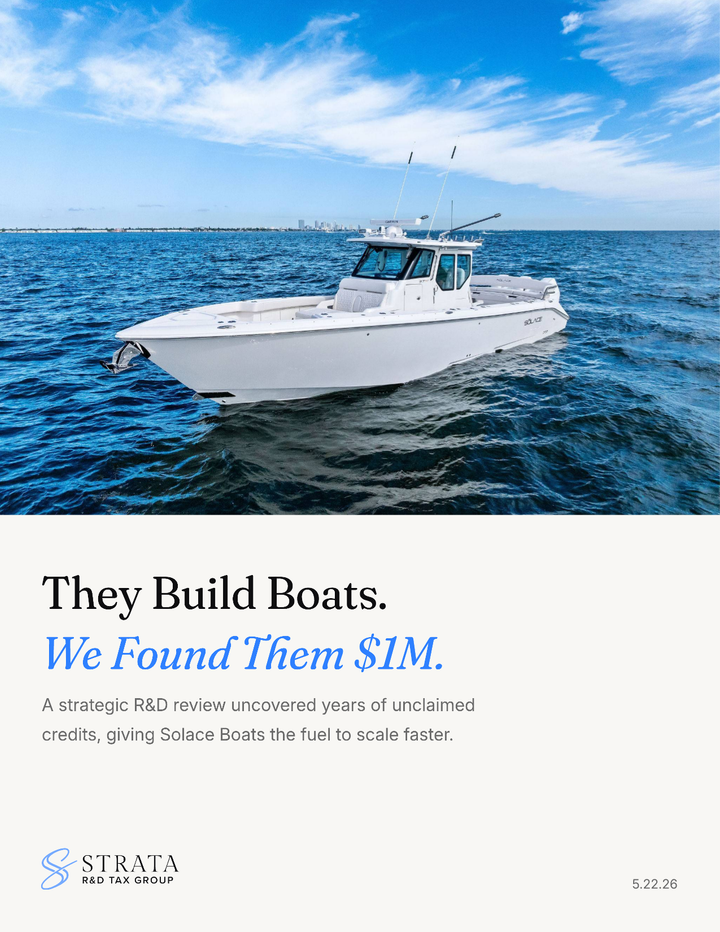
Read the full case study: How Solace Boats Turned the R&D Tax Credit Into Fuel to Scale Faster (PDF)
The work you call "just building boats" may be research to the IRS
Ask most boat builders what they did last quarter and you will hear something like: reworked a hull to fix a soft spot, tried a new resin so parts would cure faster in the shop, moved an engine mount to kill a vibration, figured out how to make a console watertight without adding weight. To the shop floor, that is Tuesday. To the federal R&D tax credit, a good portion of it may be qualifying research.
This post walks through how that kind of everyday development translated into a documented credit for one manufacturer, then lays out honestly what tends to qualify and what does not.
What the federal R&D credit actually covers
The credit lives in Section 41 of the Internal Revenue Code, and the qualifying rules are spelled out in Treasury Regulation 1.41-4 (https://www.ecfr.gov/current/title-26/chapter-I/subchapter-A/part-1/section-1.41-4). It is not a grant and it is not reserved for people in lab coats. It is a credit for the work of developing new or improved products and processes, and it is measured against a four-part test. All four parts have to be met for a given activity:
Technological in nature. The work has to rely on principles of engineering, physics, chemistry, or computer science. Naval architecture, hydrodynamics, composites chemistry, and structural engineering all fit comfortably here.
Permitted purpose. The activity has to aim at a new or improved product or process, measured by function, performance, reliability, or quality. A hull that runs drier, a layup that is lighter and stronger, a build process that cuts cure time, each can qualify.
Technical uncertainty. At the outset, the team could not have known whether the design would work, or how to achieve it, from readily available information. If you had to try, test, and adjust to find out, that is the uncertainty the credit is built around.
Process of experimentation. The team evaluated alternatives through modeling, prototyping, testing, or systematic trial and error. This is the part that documentation lives or dies on.
For the plain-language version of the rules and current forms, the IRS maintains a research credit overview (https://www.irs.gov/businesses/research-credit) and instructions for Form 6765 (https://www.irs.gov/forms-pubs/about-form-6765).
The case: how a boat builder documented $300K+
When we worked with Solace Boats, the pattern was familiar. The team was doing genuine development work and treating it as ordinary problem solving, which meant much of it was going undocumented and unclaimed.
The qualifying activity clustered in a few areas. Hull and running-surface development, where the team iterated on geometry to improve ride, stability, and efficiency and had to test on the water to know if a change worked. Layup and lamination engineering, where alternative materials, core choices, and schedules were evaluated to hit strength and weight targets. Systems integration, where fitting power, rigging, plumbing, and electronics into a hull without compromising performance or serviceability required real design iteration. And tooling and process development, where building the molds and refining the build sequence itself involved solving technical problems.
The result was a documented federal R&D tax credit of more than $300K. Individual results vary significantly depending on the specific activities, the wage and supply base, and the quality of the documentation. The number is not a promise. What made it defensible was tying each claimed activity back to the four-part test and the records that showed the experimentation actually happened: design revisions, test logs, prototype notes, and the payroll and materials behind them.
What typically does NOT qualify
Being straight about the limits is part of doing this right. Work that generally falls outside the credit includes:
Routine production once a design is finalized. Building the hundredth unit of a proven boat is manufacturing, not research.
Sea trials or QA that only confirm an existing, proven design performs as expected, with no unresolved technical question.
Purely cosmetic or stylistic changes such as gelcoat color, upholstery patterns, or trim, where no functional or performance uncertainty is involved.
Marketing, sales, and general administrative work, and duplicating a competitor's product by reverse engineering without your own process of experimentation.
Research funded by someone else, or where you do not retain rights to the results, which can be excluded under the funded-research rules depending on your contracts.
The line is not always obvious, and where an activity lands depends on the specific facts, the documentation, and how the work was actually carried out.
For owners and CFOs: what a first step looks like
If any of the qualifying categories above sound like your shop, the practical next move is a no-cost eligibility assessment. Strata offers an initial assessment at $0, and a typical engagement often runs about four to eight weeks from kickoff to a substantiated claim, depending on the state of your records and the complexity of the work.
Strata's approach is built around a simple idea: capture the full credit you have earned while keeping the claim well documented and defensible, rather than pushing aggressive positions that invite scrutiny. You can start a conversation at https://stratataxgroup.com/contact.
FAQ
Do we need a formal R&D department to qualify?
No. The credit follows the activity, not the org chart. Engineers, boat builders, riggers, and shop leads doing development and testing can all represent qualifying work, depending on what they actually did and how it is documented.
We have been building boats for decades. Can established designs still generate a credit?
Often yes, when you are improving them. New models, meaningful revisions to hulls or systems, and process improvements can qualify even for a long-established builder. Simply reproducing a finalized design does not.
What documentation matters most?
Contemporaneous records of the experimentation: design iterations and revisions, test and sea-trial logs tied to a technical question, prototype notes, and the payroll and supply records behind the effort. The stronger the records, the more defensible the claim.
Can we claim prior years?
Depending on your filing history and the facts, amended returns for open tax years may be available. Whether that applies to you is something to confirm with a qualified professional based on your specific circumstances.
This post is for informational purposes only and does not constitute tax or legal advice. Consult a qualified tax professional regarding your specific circumstances.
Author
Strata R&D Tax Group